The CPI Program:
Adapting Malasakit in the Global Arts and Cultural Workforce
Me and the CPI Program
Before anything else, I would like to introduce myself.
I am Karl P. Albais, the World Heritage Sites Coordinator of the de facto Ministry of Culture of the Philippines, that is, the National Commission for Culture and the Arts (NCCA). I am an award-winning artist, independent curator, writer, researcher, and engineer with more than 5 years of professional experience in cultural heritage management.
The CPI program was introduced to me when I received a copy of the memorandum from our International Affairs Office relative to the open invitation for the “Cultural Partnership Initiative (CPI) Cultural Administrator Training Program.” Amidst prolonged lockdowns during the time of the COVID-19 pandemic back in late 2020, I was looking for ways to expand my knowledge on cultural heritage administration. Thus the program henceforth piqued my interest. Fortunately, I received an endorsement not only from my immediate supervisor but also from my home organization, that is, the National Commission for Culture and the Arts (NCCA) in order to participate in the said program.
The said program—whose general aim is to reinforce cultural industry promotion, policy, and planning competency in cultural administrators of ASEAN member states and develop opportunities for future cooperation—trained several civil officials of cultural ministries of Southeast Asian countries from Indonesia, the Philippines, Viet Nam, Thailand, and Cambodia, who all have been selected among cultural administrators recommended by respective cultural ministries.
Specifically, this Administrator Training aimed to strengthen the capacity of cultural administrators in ASEAN countries to plan public culture projects in the post-pandemic era and to establish cultural policies that can continuously expand the recipient country's cultural accessibility and enjoyment. To this end, this short-term intensive online training offered sessions to share insights and knowledge with Korean experts. Overall, the program theme revolved around arts and culture education.
My overall expectation from the program was to connect and network with my peers in Southeast Asia in as much as to improve my knowledge and skills in cultural administration. In total, nine (9) cultural administrators have successfully completed the program.
Key Takeaways
Jointly hosted by the Ministry of Culture, Sports and Tourism of the Republic of Korea and the Korean Foundation for International Cultural Exchange (KOFICE) from 16 to 26 February 2021, the training program was facilitated through two (2) online modes, including: (a) e-learning lectures on public culture projects, in Google Class platform; and, (b) real-time webinars and thematic lectures, and expert mentoring and consultations towards the preparation and development of Project Concept Paper (PCP) for each participant, in Zoom Web Conference platform.
While the e-learning content is geared towards training the participants to build competency in public culture project planning, the real-time webinar focused both on thematic lectures and expert mentoring on PCPs. These two (2) modes of online delivery not only made the training accessible but also facilitated a holistic learning experience amongst the participants, despite connectivity issues and Internet glitches. Evidently, this international training shares affinity with the Cultural Mapping and Technical Assistance programs administered by the NCCA, with the deployment of key experts for cultural projects to certain ends.
While the e-learning content is geared towards training the participants to build competency in public culture project planning, the real-time webinar focused both on thematic lectures and expert mentoring on PCPs. These two (2) modes of online delivery not only made the training accessible but also facilitated a holistic learning experience amongst the participants, despite connectivity issues and Internet glitches. Evidently, this international training shares affinity with the Cultural Mapping and Technical Assistance programs administered by the NCCA, with the deployment of key experts for cultural projects to certain ends.
With all these in mind, the learnings in this training program could be used as alternative methodology towards the democratization of the NCCA’s competitive grants program mechanism, given that it personalizes the project concepts of possible recipients. As much as it is a grant-giving training program, it also functioned as an arts and culture education enabling platform.
What impressed me the most about this program is how seamless the training was facilitated and how culture and arts programs of South Korea are/were informed by rigorous research and backed by comprehensive statistical data. I was also amazed how Koreans were able to shift to online platforms easily from traditional modes of accessing/consuming culture and arts services and products during the time of the pandemic.
As a rallying point of my participation to the CPI Program, my future plan includes networking with my peers in Southeast Asia and in the world in general to develop cutting-edge programs and projects that foster meaningful connections and humanistic sustainable development; all the while bringing in malasakit (roughly translatable to the English lexicon as “care, empathy, or concern”) as a core Filipino value, making every activity culturally sensitive and attuned to the needs of others. In this respect, the CPI program is continually broadening my horizon as a visual artist and cultural heritage professional, with its consistent follow-through communication and activities for CPI alumni.
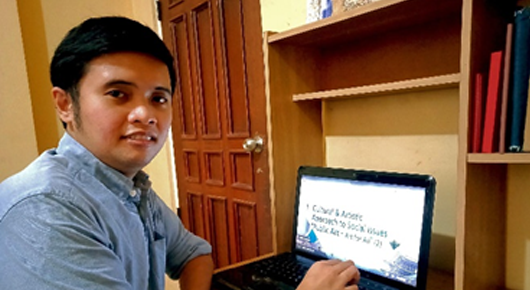
Individual Photo Opportunity of the author for his Training Participation
CPI Program Realizations
I. New Gig Economies in the New Normal
The program has generally made me realize about the current realities and contemporary social issues surrounding my fields of practice.
Artists and cultural workers in the Philippines (and the world, in general) have predominantly relied on the “gig economy,” or informal economy, for the longest time—with the prevalence of short-term contracts and freelance work—due in fact of the very nature of their respective practices, which include the following but not limited to: receiving commissions for creating artworks and/or performance work, paid residencies and grants, art consignments, art teaching stints, tutoring and mentoring, research work, among others. As further made apparent by the recent pandemic, “new gig economies” have become the “new normal” where artists and cultural workers who have been working on the digital and new media almost always transitioned in an online-based job market.
However, such online transition did not suit well for the majority of such professionals, given that their work often requires them to be “on-site” and appear “in-person” to provide a substantial contribution to an organization or a private company who wish to contract their services. Also, it must be noted that such labor framework of “gig economies” has been utilized by companies, among other institutions, as exploitation measures to ensure high profitability at a low-cost, with the nexus of marginal incentivism masquerading as “short-term” rewards.
This ordeal has already amplified every possible contemporary social issues that we have faced pre-COVID-19, including work displacement and misalignment, ballooning unemployment rate, brain drain and brain waste, equity and equality in public health, ample and adequate access to educational services, equal access to information against the proliferation of “fake news” in social media, inflation rates, natural calamities (such as typhoons and earthquakes), armed conflicts and insurgencies, food shortages and malnutrition, food security, among many others. Although the Philippines, ranks among the top countries in the world with the highest number of female executives, this does not exempt vulnerable individuals from experiencing gender-related violence and discrimination, and even gender pay gap.
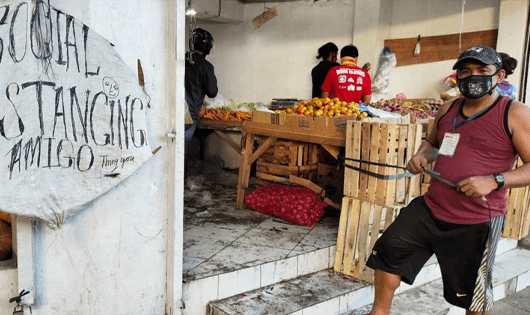
Social Distancing
Image Source: International Labour Organization
II. Malasakit in a Hyperconnected yet Fragmented World
We are living in a hypermediated and hyperconnected world, wherein: there is an avalanche of travel opportunities and unprecedented capital flows due to multiple economic activities through e-commerce, which ultimately resulted to the exponential growth of capitalistic ventures; and, the hegemonic rule of neoliberal thought has been observed, which caused irreversible degradation of our natural environment.
Filipino identity has been undermined as well due to prevailing postcolonial attitudes that are western-centric. Nevertheless, there are inherent Filipino values that can be nurtured toward promoting the common good. Our colonial experience gave rise to feelings of inferiority as manifested by our culture of hiya or shame. The pervasive undermining of what it means to be Filipino gave way for regional identities to overshadow national pride. This led to a society that has become disconnected from its core culture and is characterized by fragmented identities. Values like malasakit, bayanihan, or pangaddatan that manifest pakikipagkapwa-tao, a way that Filipinos recognize kinship among themselves, need to be inculcated for national unity and social cohesion. The concerns of culture indeed extend beyond the national borders. (Philippine Development Plan 2017-2022, 2017)
Incidences of discrimination and prevalent disinformation have been reported, due in part to lack of awareness of our diverse cultures. The Philippines has consistently shown generally weak interpersonal trust even under the “old normal.” However, it may be too early to tell the long-term effects of the pandemic to overall social capital, which also includes institutional trust and civic engagement, among other components. Transitioning to the new normal, cultural and creative enterprises and workers, especially freelancers in the gig economy, remain vulnerable. (Philippine Development Plan 2017-2022 Interim Update, 2020)
With all these in mind, malasakit has been the core of the Filipino cultural experience. Defined as a cultural value that uniquely defines how a Filipino values others, it is compassion, accountability, ownership, and putting one's interest behind others all rolled into one. In the context of the global workforce, it is what proudly separates Filipino professionals/employees from the rest.
As a way forward, such relational characteristic and tendency could be very well adapted by various communities across the arts and cultural work sectors as a mechanism/cultural framework in order to be more human in this increasingly connected but dehumanized society.
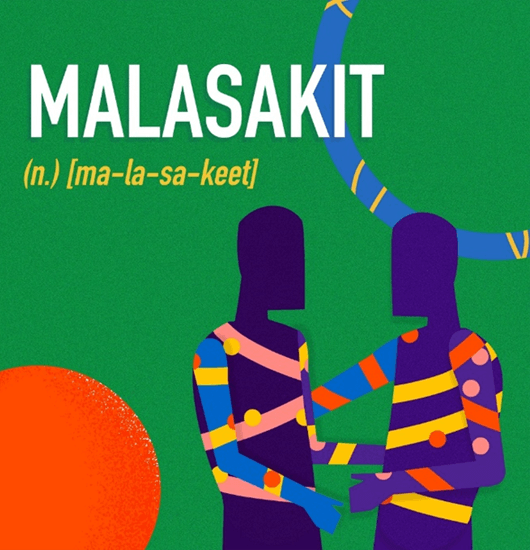
Malasakit
Image Source: 2019 SEA Games Volunteers Facebook Page
Karl P. Albais (The Philippines)
2021 Participant
World Heritage Sites Coordinator, National Commission for Culture and the Arts (NCCA)


