New participants in National Library of Korea
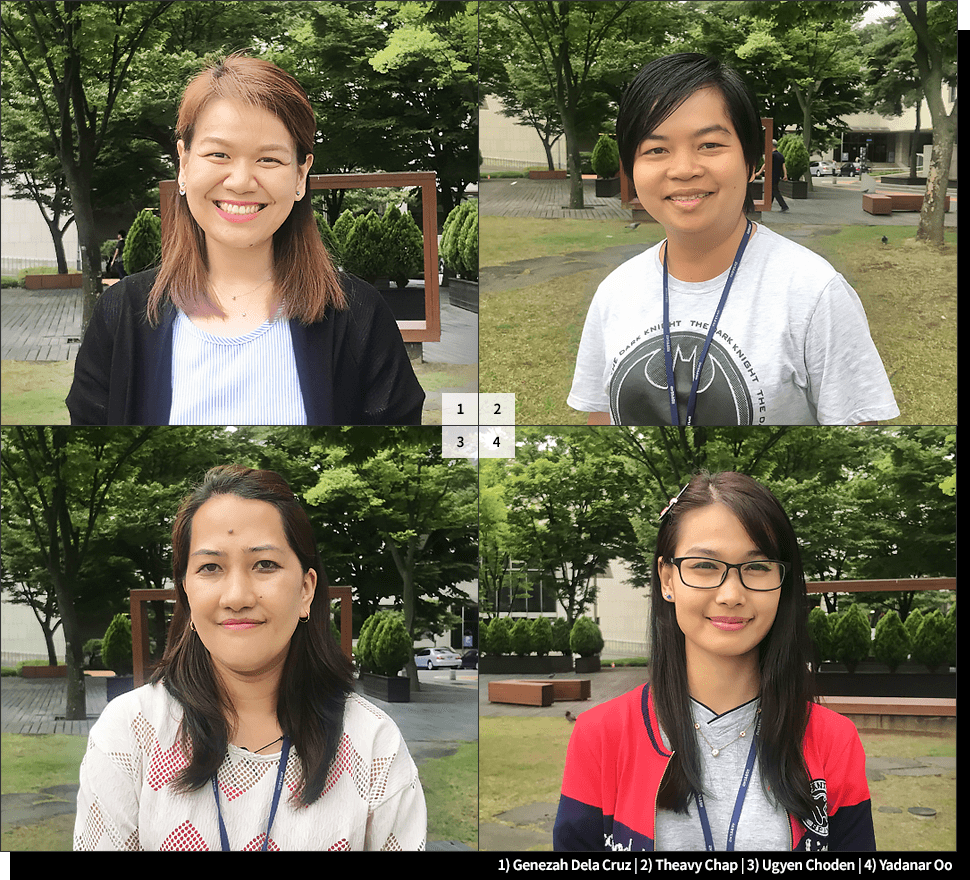
Four qualified librarians from each country(Philippines, Myanmar, Bhutan, Cambodia) had arrived Seoul as participants of National Library of Korea’s CPI program. They will see and learn practical services as librarian expertise until October 29th, including Korean culture excursions and language studies. It’s been a month since their arrival, so let’s hear their experiences so far and expectations for the future.




Welcome! Would you please introduce yourself?
Hello. I am Genezah Dela Cruz from Rizal Library, Ateneo de Manila University in Philippines. I am very grateful to be one of the 2019 CPI members. I worked as a Cataloger Librarian, in charge of describing and classifying our library’s collection, which includes a number of Korean materials like the 1)Window on Korea from The National Library of Korea.
I am Yadanar Oo from Myanmar. I’ve been working in the National Library of Myanmar for 8 years which is under the Ministry of Religious Affairs and Culture. In my case, I work especially for children’s library, classifying books and managing different kinds of tasks.
This is Ugyen Choden from the National Library and Archives of Bhutan. I’ve been with this library for 14 years. I used to catalog and classify books, and also in charge of putting information into the Koha is an open-source Integrated Library System in use today by hundreds of libraries worldwide.
2)KOHA integrated library system.
Hi, I am Theavy Chap from Senate Library of Cambodia. I have been working for the library for about 10 year, and now I am the chief administrator of the library.
1) Window on Korea is a program to introduce Korean culture by installing Korean resource center in international libraries through books.
2) Koha is an open-source Integrated Library System in use today by hundreds of libraries worldwide.
I guess the excellent experts from South East Asia have been selected for 2019 NLK(National Library of Korea) CPI. It is your first time in Korea?
It is my first time to visit Korea
For me, this is second time to be here. In 2016, I was a participant at Training Project for ASEAN Children’s Librarians.
Actually, it is my fifth time in Korea. I think my perspectives on Korea have significantly changed comparing to the time when I had the first trip to Seoul.
I wonder how you thought about Korean culture before coming. Also what have changed since then?
I had my first trip to Korea with my friends in 2016. I was just one of those typical tourists. I think I figured out Korea only through dramas on television. But now I feel entirely different that I am actually living here, I can directly feel the way of Korean people’s living. Sometimes those passers-by on streets seemed so busy and lack of emotion, but actually they were friendly and warm-hearted inside. Koreans are helpful and accommodating to foreigners like us especially when we face with some inconveniences like finding directions.
Even though I once visited before, the closeness to Korea feels very distinct. At that time, I was mere a stranger to Korea but now I feel belonged here when riding a bus or subway with local residents. I am very happy with my CPI colleagues, NLK staffs, our coordinator and Korean language teachers. Best of all, I think Kimchi is great!
I’d talk about my personal experience. It is my first time travelling abroad for this much long period. When I was accepted to this 5 months program, I was excited and worried at the same time. The fact that I had to leave my family, kids and my country made me feel so insecure. Also living with people from totally different backgrounds seemed uneasy. However, now I am enjoying my time. My CPI colleagues share new experiences, hold on to each other and overcome problems together. Also, living in a democratic country feels very different too. Everything is so liberal.
This is my first time stepping out of my country, Cambodia. I used to like K-pop songs a lot, so I am very happy to be here. I think learning local language enhances the sense of belonging so I am grateful for the language learning program in Seoul National University. Although it is extremely difficult for us to learn a language with totally new alphabets and grammar, I think it is worthy.
What did you find about your CPI organization, National Library of Korea?
I think the way technology is being used in the library is outstanding. Our library in Myanmar is trying to transform as a 3)digital library too.
NLK, is certainly advanced when it comes to the technology-like their preservation techniques, equipment use in their laboratory and the machines use to digitize their collection. It is good opportunity to see and learn. Maybe we could adopt some approaches and methods to use it in our institution.
In our country, we only have very small 4)e-library system. It is fascinating how huge the digital book system is equipped in NLK.
Right, I think everyone has same idea about the technology that NLK possesses. In terms of the library itself, I found NLK has a wide range of books. Bhutan library has two sections of books. One is the foreign language book section mostly in English, and another part is the traditional book section. The majority of collections are about Buddhism. Now that I am here, I think I can obtain many knowledge by reading exotic books.
Most of the ASEAN countries’ libraries use 5)hybrid library system, so we still have a lot to catch up. Other than the technology, I expect many experiences and knowledge to learn. As a librarian, it would be beneficial to find about the way of management, devices they use, user service system and so on. It will be very useful for our presentation as a result of NLK’s CPI program.
3) digital library refers to the set of documents available through electronic means by the use of digital technologies that allow for the retrieval, archiving, preservation, and dissemination of those documents and can be accessed 24/7.
4) same meaning as digital library.
5) A term used by librarians to describe libraries containing a mix of traditional print library resources and the growing number of electronic resources.
About the speech you are preparing for at the end of this program, did you come up with specific area you wish to study in particular?
I am specifically in to the collection development in the NLK. As I have mentioned earlier, Bhutan is mostly interested in collecting books about history and culture of Buddhism while NLK collects from various kinds of fields in general. So I’d like to learn how they classify and manage books, what kind of specific books they are collecting compared to the National Library of Bhutan.
For me, I am interested in the programs for the disabled in NLK. There is National Library for the Disabled in Korea. I might cover that area, including their responsibilities and user services.
I would like to learn about the digital library system and its service. Providing digitalized services to the costumers is not yet widespread in our country. So studying the NLK’s current state and operation will be my main research.
I want to conduct a research on promoting Korean culture by using the Window on Korea collections in our university. Korean culture is in high demand in Philippines. As the department of Korean studies has been newly established in our university, I would like to research and help develop this program to introduce Korean culture more to Philippines by using materials from NLK and Window on Korea program. I think in the future, maybe we could invite some speakers to our university to talk about Korean culture and other related topics as part of a seminar or workshop for our students or to the public. It is not a concrete plan yet, but I am expecting to build up constructive projects between Philippines and Korea.
Apart from assignments, what else do you expect to achieve for the next few months?
In the future, maybe the National Library of Bhutan and the National Library of Korea could share some practices and programs to learn each other as cultural exchange.
Other than learning Korean culture most importantly, I expect to exchange culture with other CPI participants. I think meeting new friends participating in the programs of other organizations is another advantage for us to have deeper understanding about people and cultures around the world. In addition, the National Library of Myanmar would like to make Window on Korea program to exchange culture, and especially children’s literature if we have a chance.
As we are learning Korean language, trying on traditional costume Hanbok and eating local foods help us to understand Korea properly. Some foods are very good too! Also personally, I hope to enroll for a Masters degree on Korean studies after the CPI program, expecting myself to have a glance of Korean history and culture at the end, which is beneficial for my further endeavor.