Interview with CPI alumni
Nyamaa Suvdsuren, Lê Hà Giang, and Munkhjin Purevkhuu
There are many other ways to keep and improve cultural competence after the CPI program. Many would continue their career in their hometown or somewhere else by making good use of their precious experience.
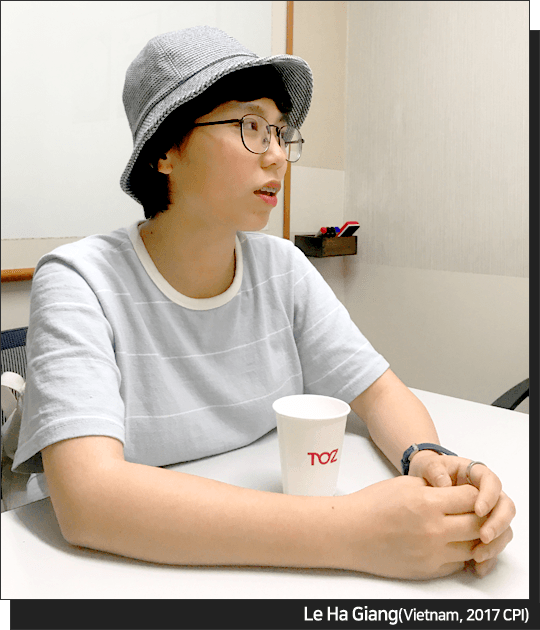
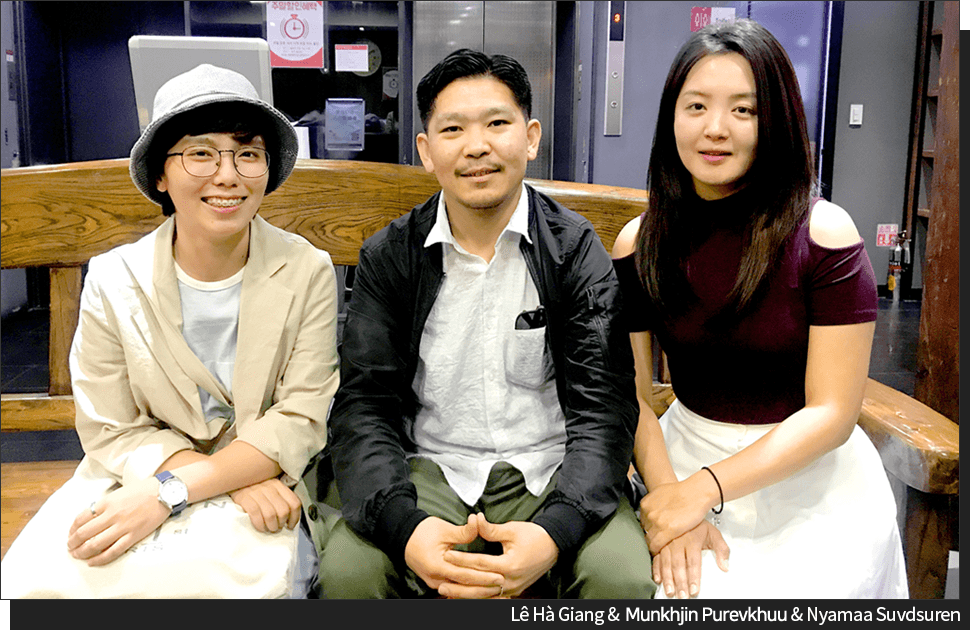
Here Munkhjin Purevkhuu(Mongolia), Nyamaa Suvdsuren(Mongolia), and Le Ha Giang(Vietnam) had determined to stay in Korea after the program, under different grounds. In Jongro, the heart of Seoul, three participants freely shared stories using Korean language.



It is good to see all of you. Do you know each other somehow?
I know Munkjin because we are Mongolians. Giang and I was at the same year of CPI in 2017 using the same dormitory. I am extremely happy to see her again. Where do you live?
Yes, we had a lot of good old memories there. Now I am currently living near my school, Korea University.
Are you studying Korean?
I go to Korean language center, and I’m planning to enter the graduate school.
I am studying Korean too, for the degree for graduation at Korea University of Arts.
I think we all are. I study At Seoul National University.
Okay, I am glad that you all have improved language skills that we can continue a group interview in Korean. Let’s hear which CPI program each of you have participated first. And please share what you have passed through, and your future plans
I participated in the CPI program by Guro Arts Valley in 2017. I was able to organize small town tours, linking with local history. I used to picture images about Korea with K-pops during my high school years, but since the CPI program, I have grasped better about Korean culture. Now I study Korean language for graduate school admission. I wish I could learn more about preserving cultures in the graduate school course.
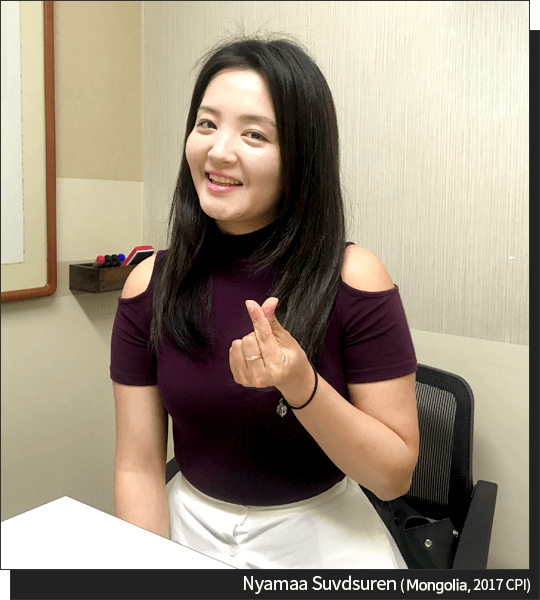
I was with Trust Dance Company in 2017 as a traditional dancer. I learned Korean contemporary dance and worked with the disables. The instructors and members of the company were so supportive that I gained an understanding about what ‘contemporary art’ is. I loved Korea and wanted to study more here, so I applied for graduate school on arts management.
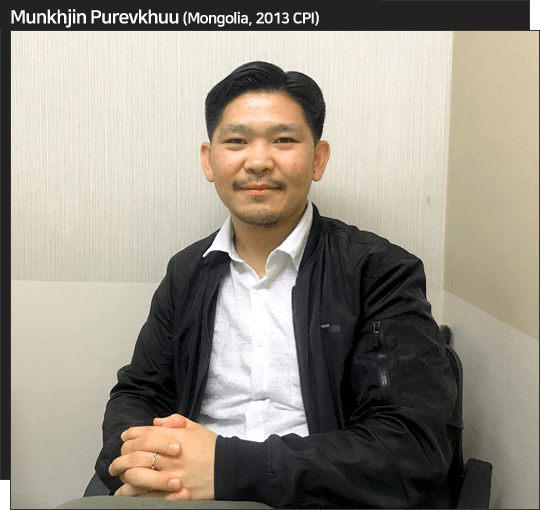
It has been 6 years since I attended CPI. I was one of the 13 members of the National Theater of Korea’s CPI program. I am the morin khuur player, which is a traditional Mongolian string instrument. After the program, I came back and performed at several performances. And I also composed some songs based in Korean and Mongolian instruments. I am currently in Korea National University of Arts studying traditional music composition through scholarship student for foreigners. I would like to work as a professor at Mongolian National Culture and Arts University after graduation.

Sounds like you all had invaluable time through CPI. As a program manager or an artist, what is the essential reason why you have opted to live in Korea in terms of your field?
It was noteworthy that Korean government and people are putting significant effort to their indigenous culture and arts than Mongolians are doing. It convicted me that different forms of traditional heritages must be kept for good.
I quite agree with Nyamaa’s idea that Korean cultural policies and backgrounds are well established. I felt that Korean cultural organizations are promoting their culture, not just appealing to foreigners, but also inspiring public to be culturally aware. My home country Vietnam, for instance, are not yet so skillful at it. It is still way to simple and unsophisticated.
Also I was impressed how Korea keeps developing their traditional arts into contemporary arts. Mongolians are likely to regard the tradition boring, but we are also beginning to transform the olds. I found out that our traditional arts were very close to those of Korea. From the fact that we find similarities as a north-eastern Asian country, Mongolia can highly take Korea as an appropriate reference.
I have a different perspective. There is an incessant dispute on looking at traditional arts, but after CPI program I got to hold the view that tradition should be kept intact as possible. I know this is a kind of conservative view. But I think tradition may be too vulnerable to change at a fast pace.
Munkjin, it seems you have done lots of works in and out of Korea after you finished CPI program. Tell us more about the works and your thoughts.
True, I’ve done some works since 2013. I performed with Cheongju Orchestra several times, sometimes performed in Mongolia with Korean music, and also composed songs with Mongolian and Korean instruments, to name a few. I particularly like Piri concerto made for Jeju island. I admire Korean traditional orchestra and I want to make Asian orchestra just like European countries do. I think Asian must work and research together. I decided to stay and study more in Korea because I could feel Koreans are actively developing their culture, and recently collaborating with other Asian countries noticeably, which was right on point with my thoughts. I had to grab a chance at that time of the moment. Even now, there are lots of opportunities if you are keen on it.
As of people who truly fulfilled the ultimate goal of CPI program, how can the CPI program be improved further?
CPI really changed my critical thoughts about culture, and I am very thankful about it. Even after the program, the reunion event in my home country is also helpful that I can meet different Vietnamese who have experienced Korean culture. But frankly speaking, I hope I can meet my old CPI members from that year. That would genuinely make us feel like a real ‘reunion’.
We don’t even have the ‘reunion day’ in Mongolia! But I do wish there would open a Korean Cultural Center in our country too. There are many Mongolian people who want to experience Korean culture. The demand is distinctively high.
Some may doubt whether the skills learned in Korea is practically useful in our home country or not. But one of my CPI colleague from Nigeria instructed Korean instrument Janggu class in Korean Cultural Center in Nigeria to local students. CPI does provide great opportunity for the participants. The best thing is that I got to have excellent musician friends from all over the world.